· Industry Insights · 12 min read
Fashion Stocklots: The Complete Guide to Buying Wholesale Overstock Clothing
Fashion stocklots are unsold, first-quality garments from cancelled factory orders — available at a fraction of retail cost. Here's everything bulk buyers need to know to source them profitably.
What Are Fashion Stocklots? (The Direct Answer)
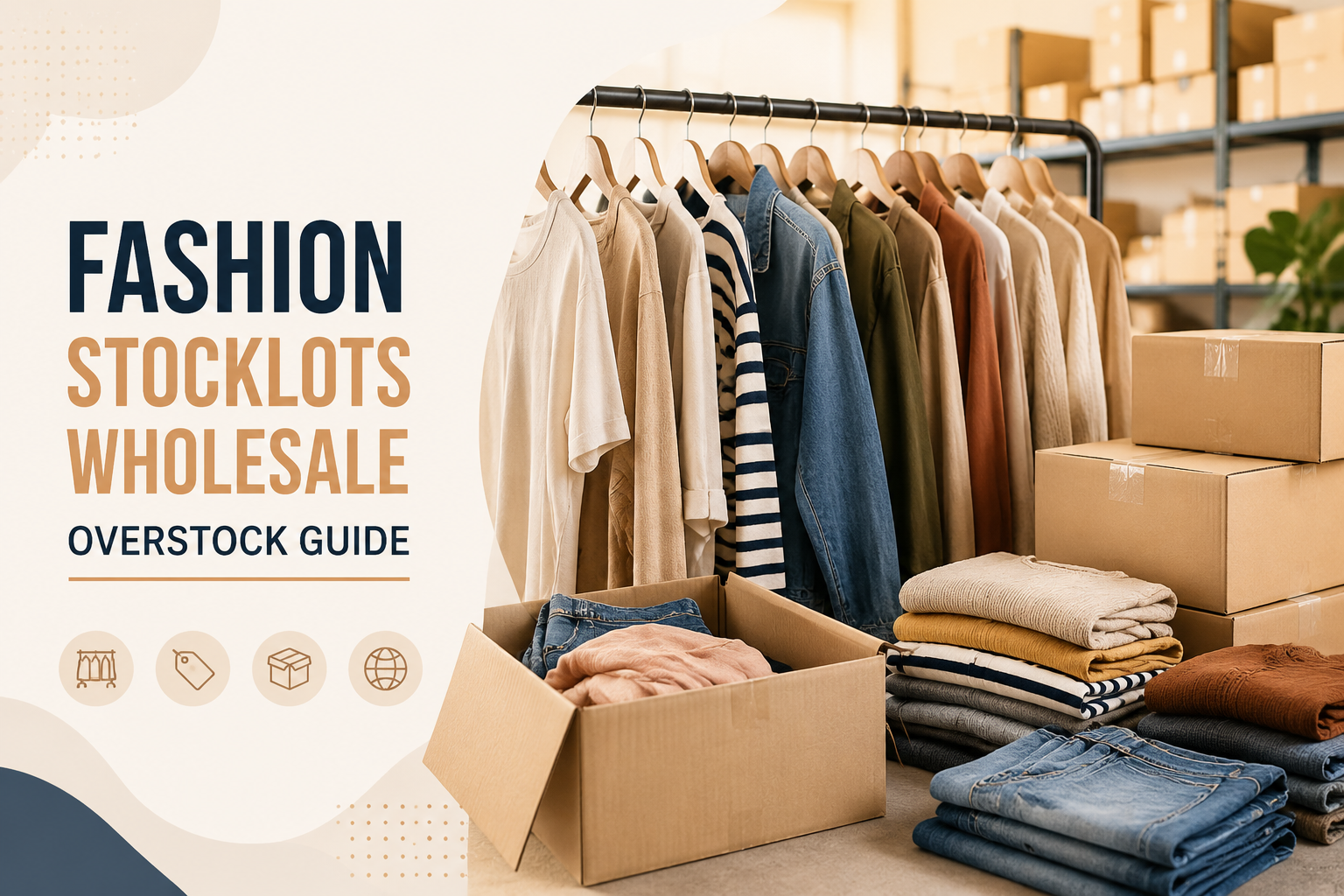
Fashion stocklots are bulk quantities of unsold, finished garments that were manufactured for a specific retail buyer — and never delivered. They enter the wholesale market because of cancelled purchase orders, retail programme overproduction, missed shipping windows, or brand discontinuation decisions.If you are looking for stock lots wholesale opportunities, these represent the most cost-efficient route into branded-spec inventory.
The key point: fashion stocklots are not seconds, not returns, and not factory rejects. They are first-quality, defect-free clothing — stitched, tagged, and packed — that exist in surplus because of a commercial failure upstream, not a manufacturing failure.
For wholesale buyers, importers, and resellers, fashion stocklots represent the most cost-efficient route into branded-spec inventory. Because the original manufacturing cost has already been absorbed by the factory or original buyer, stocklot pricing reflects the urgency of clearance — not the cost of production. Buyers routinely acquire fashion stocklot clothing at 10–30% of the original retail price.
The three main sources of fashion stocklots:
- Cancelled purchase orders — a retailer pulls out of a confirmed programme before shipment; the factory holds finished goods with no buyer
- Overproduction — a factory produces above the confirmed order quantity as a buffer; the surplus is sold off as stocklot
- Retail programme cancellations — a brand or chain discontinues a category or season; finished inventory is cleared through the wholesale stocklot market
If you are sourcing fashion clothing stocklots for the first time, the most important thing to verify is provenance: where did the lot come from, why is it available, and can the supplier document the answer? Genuine fashion stocklots come with commercial invoices, packing lists, and original factory tags. Lots that cannot be traced to a manufacturing origin should be treated with caution.
If you are looking for a reliable partner to source these liquidations, explore our main EcoStocklots Wholesale Platform, where we list verified surplus direct from clothing factories.
Browse our current take-all fashion stocklot inventory → Browse our Stock Lots Wholesale Catalog
Why Stock Lots Wholesale Is the Smartest Buy in Fashion Clothing
The fashion stocklot market exists at the intersection of two realities that the mainstream wholesale industry rarely acknowledges together: the scale of global overproduction, and the commercial logic of clearance.
Global fashion production is structurally oversupplied. Industry estimates consistently place unsold new inventory at between 20–30% of total annual production — meaning that for every ten garments manufactured, two to three never reach a consumer. Some of that surplus is destroyed. A significant portion enters the stocklot wholesale clothing market, where it is redistributed to buyers who can move it at volume.
For buyers, this creates an opportunity that newly manufactured clothing cannot match on pure economics. A fashion stocklot of 5,000 units of first-quality cotton jersey dresses — manufactured to a major retailer’s specification, finished with original tags, packed and ready to ship — can be acquired at a fraction of what it would cost to manufacture the same garments from scratch. The design risk, the production risk, and the quality control cost have all been paid upstream. The buyer inherits the product, not the risk.
The margin arithmetic is straightforward. Fashion clothing stocklots acquired at clearance pricing and resold through discount retail, online marketplaces, or export channels consistently generate margins that made-to-order wholesale cannot approach. This is why experienced apparel importers, discount retailers, and online resellers allocate a significant portion of their buying budget to the stocklot market — not as a fallback, but as a primary strategy.
Types of Fashion Stocklots You’ll Encounter
Not all fashion stocklots are the same, and understanding the different lot types prevents expensive mistakes.
Take-all lots are the purest form of fashion stocklot. A factory holds a single cancelled-order programme — 8,000 pairs of chinos, or 12,000 jersey dresses, or 15,000 polo shirts — and sells it as a single, undivided unit. The buyer takes the entire lot at a single per-unit price. Take-all lots offer the strongest economics and the most transparent provenance: what you see in the manifest is exactly what you receive. They are the preferred acquisition format for experienced stocklot buyers — and the format that most clearly demonstrates why sorted stock lots outperform mixed lots on total acquisition cost, not just headline price.
Mixed lots aggregate surplus from multiple programmes or multiple factories into a single purchase. They offer broader style variety within a single order but require more careful QC on receipt, because the consistency of a single-programme lot is replaced by the variability of multiple production sources. If you are weighing mixed lots against sorted factory overstock — including what each type actually costs once the goods arrive — see our detailed breakdown: Mixed Lots vs Sorted Stocklots: Which Type Fits Your Business?
Seasonal overstock accumulates at the end of retail buying seasons, when unsold programme inventory from spring/summer or autumn/winter collections enters the clearance market simultaneously. Seasonal stocklot windows produce the largest volume of available fashion stocklots and the most competitive per-unit pricing — but also the most competition among buyers.
Ongoing factory surplus is the category less visible to occasional buyers but most valuable to those who maintain direct factory relationships. Factories that run on a continuous production model generate small to mid-size surplus lots on an ongoing basis, independent of seasonal retail cycles. For buyers who can monitor these sources, ongoing factory surplus offers consistent access to fashion clothing stocklots outside the peak seasonal windows.
How to Evaluate a Fashion Stocklot Before Buying
The due diligence framework for fashion stocklot acquisition is consistent across categories. These are the checkpoints experienced buyers run before committing.
Verify the provenance. A legitimate fashion stocklot supplier should be able to tell you, specifically: which factory produced the lot, for which original buyer, and why the lot is available for clearance. If the answer is vague or evasive, that is meaningful information. Genuine cancelled-order stocklots have a clear story. Manufactured-to-order inventory dressed up as stocklot does not.
Request the full manifest. Before agreeing to a price, you should have a complete packing list: style-by-style, colour-by-colour, size-by-size unit counts. The manifest tells you whether the lot has a usable size ratio, whether the style mix suits your market, and whether the stated unit count is accurate. Any supplier who cannot provide a manifest before purchase is not operating transparently.
Inspect the physical goods. For any purchase above your risk threshold, insist on either physical inspection or video inspection of the actual lot — not stock photography, not sample units from a different production run. EcoStocklots provides live WhatsApp video inspections for every current inventory lot. This is standard practice for legitimate fashion stocklot suppliers; it should not be an exceptional request.
Check documentation completeness. Genuine fashion stocklots ship with: a commercial invoice itemised by style and quantity, a packing list matched to actual carton contents, a certificate of origin, and original garment care/content labels intact. Missing or inconsistent documentation is a red flag that the lot’s provenance may not be what the supplier claims.
Assess condition disclosure. First-quality factory overstock is not the same as retail returns, grade-B surplus, or mixed condition lots. A credible fashion clothing stocklot supplier discloses condition clearly and does not mix grades without explicit disclosure. If a supplier is reluctant to confirm in writing that a lot is first-quality, defect-free product, that reluctance is your answer. For a full comparison of what Grade A zero-defect lots look like versus mixed or unsorted stock, read our guide on understanding stocklot meaning and lot types.
Fashion Stocklot Categories: Where the Best Opportunities Sit
The fashion stocklot market covers every apparel category, but the opportunities are not evenly distributed. These are the categories where stocklot buying consistently delivers strong results.
Tops and T-shirts. The highest-volume category in the fashion stocklot market. Jersey T-shirts, polo shirts, blouses, and casual tops appear in large programme lots regularly — particularly from factories supplying major value-fashion chains. Core colours in standard fits are universally liquid: they sell in every market, in every season, through every resale channel.
Denim and bottoms. Core-wash denim jeans in straight and slim fits are the most consistently demanded stocklot category globally. Demand does not have a meaningful off-season, and sell-through is predictable in ways that fashion categories cannot match. Chinos and casual trousers in neutral colours follow a similar logic. Before committing to a denim lot, read our dedicated stock jeans sourcing guide — covering the three types of jeans stock lots, the denim variables that determine value, and the full documentation checklist before payment. Outerwear. High-value per-unit stocklots in jackets, coats, and padded outerwear appear primarily in the post-season clearance windows (January and July). The per-unit acquisition price is higher than in basics categories, but the margin on resale is correspondingly strong — and well-sourced outerwear stocklots are among the fastest-moving lots in the discount retail channel.
Knitwear and sweatshirts. A consistently undervalued category in the stocklot market, for the same reason as nightwear — fewer buyers are actively monitoring it. Programme-scale knitwear lots from major retail buyers represent strong value for buyers who have the resale infrastructure to move volume.
Childrenswear. Demand for affordable childrenswear is structurally robust across every market segment and geography. Childrenswear stocklots in core basics — T-shirts, leggings, jersey sets — move quickly through discount retail and online resale channels. The category benefits from a wide addressable market and consumer price sensitivity that makes stocklot pricing genuinely competitive with retail.
The Logistics of Buying Fashion Stocklots
Acquiring a fashion stocklot is not just a sourcing decision — it is a logistics decision, and the two cannot be separated.
Minimum order quantities and lot sizes. Genuine take-all fashion stocklots are sold as complete units — the buyer takes the entire lot. Lot sizes in the stocklot market range from a few hundred units (for niche or end-of-line surplus) to tens of thousands of units (for major cancelled retail programmes). Buyers who cannot absorb a full lot at the stated size either need to find a supplier who brokers partial lots, or partner with another buyer to co-acquire. Splitting lots adds complexity but is common practice among smaller buyers entering the stocklot market.
Shipping and freight. Fashion stocklots ship via sea freight (FCL or LCL depending on volume), air freight (for high-value, time-sensitive lots), or road freight (for intra-continental movements). The freight calculation — per-unit shipping cost relative to per-unit acquisition price — is a critical part of the stocklot economics. A lot with strong per-unit pricing can be rendered uneconomic by freight costs if the goods are heavy, bulky, or require complex documentation for customs clearance.
Import duties and customs classification. Every garment category has a specific HS code that determines the applicable import duty rate. Fashion stocklots spanning multiple categories may require multiple HS codes on a single shipment. Work with a freight forwarder experienced in apparel importing before committing to a lot — duty miscalculation is one of the most common and most avoidable costs in stocklot importing.
Warehousing and turnover. Fashion stocklots are not perpetual inventory. They are fixed quantities of finished goods that need to move. Before acquiring any lot, have a clear plan for how the inventory will be sold — through which channels, at which price points, and within which timeframe. Carrying cost (warehousing, insurance, financing) erodes stocklot economics if turnover is slow. The best stocklot buyers are not just good at acquiring; they are good at moving.
How Resellers Turn Stock Lots Wholesale Into High-Margin Profits
Acquisition is only half of the stocklot equation. The exit strategy determines whether a lot is profitable or merely occupied warehouse space.
Discount retail supply. The highest-volume exit channel for fashion stocklots in most markets. Discount retailers, off-price chains, and independent fashion stores are active buyers of stocklot clothing in single-programme lot quantities. They require consistent condition, accurate manifests, and reliable delivery — but they absorb large volumes quickly and provide predictable payment terms.
Online marketplace resale. Individual listing on platforms that support per-unit or small-pack selling allows buyers to extract significantly higher per-unit margins than wholesale supply, at the cost of time and logistics overhead. This channel works best for lots with strong individual product photography potential — tops, dresses, knitwear.
Export to secondary markets. Many fashion clothing stocklots that are difficult to move in their country of purchase are highly liquid in secondary markets where equivalent clothing retails at a premium. Eastern Europe, West Africa, Southeast Asia, and Latin America are active destinations for fashion stocklot exports from buyers who acquire in volume in Europe or North America.
Lot resale to smaller buyers. Buyers who acquire large lots directly from factory sources can create their own margin by breaking lots into smaller quantities for buyers who cannot meet factory-direct lot sizes. This requires no retail infrastructure — only sourcing relationships, logistics capability, and the commercial credibility to sell to other buyers at confidence.
EcoStocklots: Take-All Fashion Stocklots, Sourced Directly
At EcoStocklots, every lot we list is genuine factory overstock — cancelled-order and overproduction clearance sourced directly from manufacturing facilities, with full export documentation and original tags intact.
For global buyers looking to secure high-margin apparel directly from source factories, navigating the surplus market requires a trusted gateway. You can visit our EcoStocklots Homepage to explore how we curate, inspect, and export premium overstock garments worldwide.
Our take-all fashion stocklot collection is updated regularly with verified lots across all apparel categories: tops, bottoms, dresses, outerwear, knitwear, and more. Every take-all lot is listed with a full manifest, transparent condition disclosure, and direct-from-factory provenance. No broker chains. No manufactured-to-order inventory dressed up as overstock.
For buyers building a serious fashion stocklot programme, take-all lots represent the cleanest acquisition format: single provenance, single price, complete documentation, and no ambiguity about what you are buying.
Browse current take-all fashion stocklot inventory → View All Take-All Stocklots
Real-time inspection available: We provide live video inspections via WhatsApp for any current inventory lot. Chat with our sourcing team.
EcoStocklots is a B2B wholesale platform specialising in factory overstock apparel clearance. We connect global importers, discount retailers, and online resellers with verified, defect-free surplus inventory at competitive bulk pricing.