· Industry Insights · 9 min read
Bulk Nightwear: How to Source Factory Overstock Sleepwear Without Getting Burned
Nightwear is one of the most consistently undervalued categories in the stocklot market. Here's what experienced bulk buyers know about sourcing it — and why most first-timers overlook it entirely.
The Category Every Bulk Buyer Underestimates
Ask any experienced stocklot buyer which apparel categories they watch most closely, and denim will come up immediately. Outerwear. Basics. Sportswear. These are the categories that get attention, get written about, and get fought over when a strong lot comes to market.
Nightwear rarely makes that list — and that is precisely why it represents one of the most consistent opportunities in bulk clothing sourcing today.
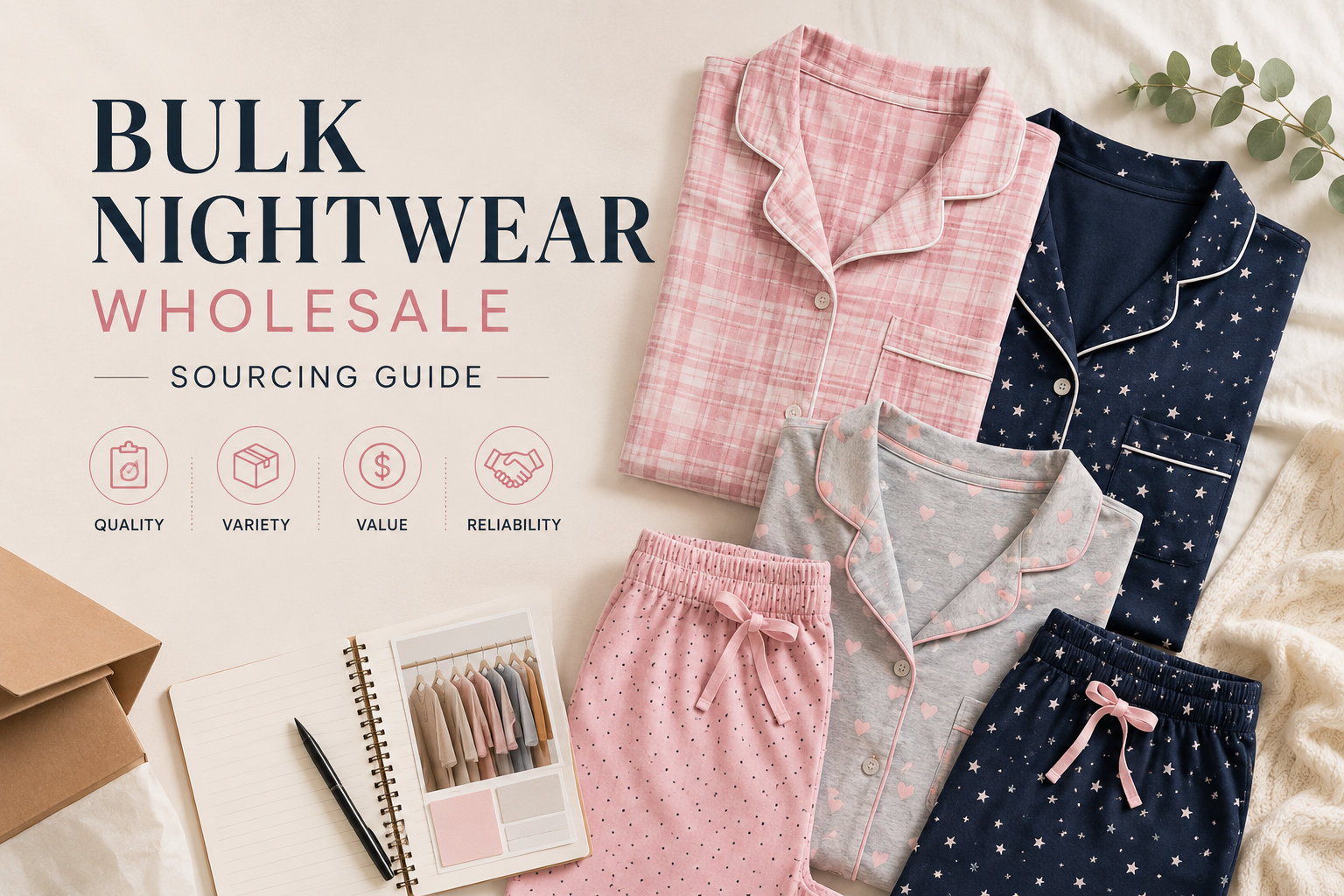
Bulk nightwear — pyjama sets, sleep shirts, robes, loungewear separates — occupies a category with year-round consumer demand, low style risk in core styles, strong sell-through in discount retail, and a factory overstock pipeline that most buyers simply aren’t monitoring. While the competition for a container of mid-blue denim stocklot can be fierce, a verified lot of 8,000 units of cotton pyjama sets in standard sizes often sits available for longer than it should, simply because fewer buyers are looking.
For importers and resellers willing to look beyond the obvious categories, bulk nightwear sourcing is a genuine edge — if you know what to look for.
What “Bulk Nightwear” Actually Covers
Nightwear is a broader category than most buyers initially assume. In the context of overstock wholesale clothing, the term covers several distinct product types that have different market dynamics, different fabric requirements, and different resale profiles.
Pyjama sets. The core of the nightwear category. Two-piece constructions in woven cotton, cotton flannel, jersey knit, or satin-style polyester. Long-sleeve/long-pant sets dominate autumn/winter stocklot pipelines; short-sleeve/short sets peak in spring/summer overproduction. Pyjama sets are the most liquid product in bulk nightwear — they have universal recognisability, clear gifting value, and broad age-range demand.
Sleep shirts and nightgowns. Single-piece sleepwear in cotton or jersey, typically targeted at the women’s market. These appear frequently in cancelled-order stocklots because they are produced in large programme quantities for major retailers and their seasonal exposure is high — a slow autumn at retail can produce substantial surplus in this subcategory.
Robes and dressing gowns. Heavier, higher-value units in cotton terry, coral fleece, or woven cotton. Robes carry stronger unit economics than pyjama sets but have a narrower resale market — they sell well in gifting contexts and in markets where in-home loungewear is culturally embedded. Less universal than pyjama sets, but high-value lots.
Loungewear separates. The category boundary between nightwear and casual loungewear has blurred significantly in recent years — a trend accelerated by the post-pandemic shift toward at-home dressing. Matching co-ord sets, oversized sleep shorts, and printed leisure pants are now as likely to be worn outside the home as in it. This crossover increases the addressable resale market considerably.
Understanding which subcategory you’re looking at within any bulk nightwear lot determines your resale strategy, your target buyer, and your risk assessment. A mixed lot of all four subcategories requires a different exit plan than a single-programme lot of 12,000 cotton pyjama sets.
Why Factory Overstock Is the Right Source for Nightwear
The nightwear category has characteristics that make factory overstock a particularly strong sourcing channel compared to other acquisition routes.
Programme-driven production creates large, clean lots. Major retailers — department stores, supermarket chains, value fashion groups — buy nightwear in large, consolidated programmes. A single seasonal nightwear buy might cover 50,000 to 200,000 units across a range of styles and sizes. When that programme is cancelled, reduced, or overproduced, the resulting stocklot is large, well-organised, and typically first-quality. You are not sorting through mixed returns or grade-B clearance. You are acquiring a uniform, specification-matched lot of finished goods.
Nightwear overproduction is structurally consistent. Seasonal timing makes nightwear one of the highest-risk categories for retail overproduction. A warm autumn reduces flannel pyjama sell-through. A late spring heatwave kills long-sleeve cotton sets bought for a winter promotion. A supply chain delay that shifts delivery past the gifting season renders an entire pyjama programme commercially obsolete for its original buyer. These structural patterns mean bulk nightwear appears in the stocklot market regularly, not just occasionally.
Core nightwear has minimal trend exposure. A classic navy-and-white stripe cotton pyjama set or a plain grey jersey sleep shirt does not go out of fashion. Unlike denim (which has clear fit cycles) or outerwear (where colour and silhouette date quickly), core nightwear styles have a commercial shelf life measured in years, not seasons. A stocklot of classic-construction cotton pyjamas acquired today is as sellable in eighteen months as it is now.
The Fabric Variables That Drive Value in Bulk Nightwear
Fabric is the single most important variable in evaluating a bulk nightwear lot. It determines consumer positioning, retail price point, care requirements, customs classification, and your ability to move the lot in your specific market.
Cotton woven (poplin, cambric, flannel). The premium tier of the nightwear category. Woven cotton pyjamas carry the highest consumer perceived value, photograph well for e-commerce, and command the strongest retail margins. Flannel specifically is a category staple in northern European and North American markets during the cooler months. The trade-off is weight and pack density — woven cotton nightwear ships heavier than jersey and takes up more carton space per unit.
Cotton jersey and single jersey knit. Mid-tier positioning. Softer against the skin than woven, easier to care for, and lighter to ship. Jersey nightwear is the dominant format in the mid-market retail segment globally. Most supermarket-tier and value-fashion nightwear programmes are built around jersey construction. In stocklot terms, jersey nightwear lots are the most frequently available and the most broadly liquid.
Polyester satin and charmeuse-style fabrics. Mass-market satin nightwear is a consistent category in the bulk nightwear stocklot pipeline, particularly in women’s styles. Per-unit costs are low, the product photographs with high appeal, and it sells well in markets where price sensitivity is high. The limitation is durability — polyester satin nightwear is perceived as a lower-quality product in markets with stronger natural-fibre preferences.
Coral fleece and plush. A strong performer in cold-climate markets. Coral fleece robes and pyjama sets appear regularly in autumn/winter stocklot pipelines. The category has high consumer appeal in gifting contexts. The challenge is that coral fleece is a category with genuine seasonality — a large fleece nightwear lot acquired in spring requires warehousing until the autumn selling window, which adds carrying cost to your economics.
Bamboo and modal blends. A growing subcategory driven by the wellness and sustainable-living consumer segments. Bamboo and modal nightwear commands a premium retail price point and is increasingly appearing in factory overstock pipelines as production of this fabric type has scaled. For buyers targeting health-and-wellness or premium discount retail channels, this subcategory is worth monitoring specifically.
Size Ratios, Packaging, and the Details That Determine Profitability
The economics of a bulk nightwear lot are not determined by the per-unit headline price alone. Several secondary variables affect your actual landed cost and your ability to move the inventory efficiently.
Size ratio distribution. Pyjama sets and nightwear in general tend to have more balanced size ratios than bottoms, because the fit tolerance of nightwear is higher — a consumer who takes a medium might comfortably wear a large in a relaxed sleep shirt. However, cancelled-order nightwear lots from large retail programmes can carry distorted ratios if the retailer had already pulled through part of the assortment before cancellation. Always request a full size breakdown before committing.
Packaging format. Factory nightwear can be packaged in three different formats, each with different implications for your resale channel. Polybag-and-hanger is retail-floor ready and adds no cost. Folded polybag is appropriate for shelf or drawer retail and for e-commerce. Boxed presentation packaging adds per-unit value for gifting channels but increases volume and shipping cost. Know which format your exit channel requires before you evaluate lot pricing.
Set completeness. For pyjama sets and co-ord loungewear, verify that the lot is fully matched — that every top has a corresponding bottom in the correct size. Factory overstock lots occasionally have top-to-bottom ratio mismatches resulting from quality rejects on one component during production. A lot with 10,000 tops and 9,200 bottoms is not a 10,000-unit lot of pyjama sets.
Country of origin and fibre content labelling. Nightwear imported into regulated markets — the EU, UK, US, Canada, Australia — must carry accurate fibre content and country of origin labelling in the destination market’s language requirements. Verify that the existing labels on any bulk nightwear lot meet your import market’s requirements before purchasing, or factor relabelling costs into your landed cost calculation.
Who Buys Bulk Nightwear — and How to Reach Them
The resale market for bulk nightwear is broader than most buyers realise. Understanding your exit channels before you acquire shapes how you evaluate which lots to prioritise.
Discount retailers and value chains. The highest-volume exit route for bulk nightwear in the UK, Europe, and North America. Cotton pyjama sets and jersey sleepwear move reliably through off-price retail channels, particularly in the pre-Christmas period when nightwear is a high-velocity gifting category.
Online marketplaces. Nightwear is among the most consistently strong performers in marketplace resale. It photographs simply, ships at low weight, has universal demand, and generates low return rates when sized accurately. Buyers with established marketplace infrastructure can extract significantly higher per-unit margins from a nightwear stocklot than from the same volume of jeans or casualwear.
Supermarket and grocery non-food buyers. In the UK and across much of Western Europe, supermarket non-food aisles are a significant nightwear channel — particularly at seasonal gifting peaks. Buyers who supply supermarket-tier non-food ranges actively seek competitively priced nightwear in large single-programme lots.
Export to warm-climate markets. Short-sleeve jersey nightwear and lightweight satin sets have strong year-round demand in warm-climate markets across West Africa, Southeast Asia, and the Middle East. These markets absorb large quantities of competitively priced nightwear that is unsellable in its country of origin due to seasonal timing mismatches.
EcoStocklots: Factory Overstock Nightwear Sourced Directly
At EcoStocklots, our inventory spans men’s, women’s, and children’s apparel across all categories — including nightwear and loungewear lots sourced directly from factory overstock and cancelled-order programmes. Every lot is first-quality, defect-free, and ships with full export documentation.
If you’re building a nightwear programme from factory surplus, our sleepwear wholesale collection includes loungewear separates and relaxed-fit bottoms that cross over with the nightwear and at-home dressing categories. For buyers sourcing across all bottoms categories, our bulk nightwear wholesale inventory is updated regularly with verified factory overstock lots.
New nightwear and loungewear lots are listed as they become available — contact our sourcing team directly to be notified when relevant inventory arrives.
Real-time inspection available: We provide live video inspections via WhatsApp for any current inventory lot. Chat with our sourcing team.
EcoStocklots is a B2B wholesale platform specialising in factory overstock apparel clearance. We connect global importers, discount retailers, and online resellers with verified, defect-free surplus inventory at competitive bulk pricing.