· Style Guides · 11 min read
How to Wear a Polo Shirt: The Ultimate Business Casual Guide
Is a polo shirt business casual? The answer depends entirely on how you wear it. Here's the definitive guide to making the polo work across every professional context — without looking like you just walked off a golf course.
The Polo Shirt Has an Identity Problem
Few garments occupy as contested a position in menswear as the polo shirt. It lives in a permanent no-man’s land between smart and casual — too formal for a weekend barbecue, not formal enough for a boardroom, and perpetually misunderstood by everyone in between.
The result is a garment that is simultaneously one of the most purchased items in professional wardrobes globally and one of the most frequently worn incorrectly.
The question that brings most people to this topic — is a polo shirt business casual? — does not have a clean yes-or-no answer. It has a more useful answer: it depends entirely on the execution. A polo shirt can look polished, intentional, and entirely appropriate in a professional context. It can also look like an afterthought, a compromise, or a dress code violation — often while being the exact same garment, worn by the exact same person, in the exact same office.
The difference is not the polo. The difference is how you wear it.
Are Polo Shirts Business Casual? Understanding the Dress Code Logic
Before getting into styling specifics, it’s worth establishing why the polo shirt sits where it does in dress code hierarchies — because understanding the logic makes the styling decisions that follow much easier to apply.
Business casual is not a single defined standard. It is a retail spectrum that directly drives consumer demand, which is why smart inventory managers heavily rely on wholesale polo shirts and apparel clearance pipelines to keep up with seasonal shifts. In a tech company where “business casual” effectively means smart jeans and a clean shirt, a polo shirt is entirely comfortable. In a financial services firm where business casual means no tie required but everything else remains structured, a polo shirt requires considerably more care to execute correctly.
The polo shirt’s dress code position is determined by two of its construction features: the knitted fabric (which reads more casual than a woven shirt) and the collar (which reads more formal than a crewneck T-shirt). It is the collar that makes the polo shirt a viable business casual option at all. Remove the collar and you have a T-shirt. Keep it, and you have a garment that can, with the right styling, function at a professional level.
So are polo shirts business casual? In most modern business casual environments, yes — provided the fit is right, the fabric has sufficient structure, and the rest of the outfit is calibrated accordingly. The polo shirt earns its place in business casual dressing by association with its better elements. Your job as the wearer is to reinforce those elements rather than undermine them.
The Non-Negotiables: Fit, Fabric, and Condition
Every styling decision that follows is contingent on three foundational variables. Get these right and a polo shirt can work in almost any business casual environment. Get them wrong and no amount of styling will save the look.
Fit is the most important variable. A polo shirt that is too large reads immediately as casual — the excess fabric creates a relaxed, informal silhouette that undermines the collar’s formality entirely. The shirt should fit cleanly across the shoulders (the seam sitting at the shoulder point, not dropping toward the upper arm), lie flat across the chest without pulling, and have a body length that sits at the hip without excess. The sleeves should end mid-bicep with a clean, close fit — not hanging loosely around the upper arm. If a polo shirt fits you like a T-shirt you’re not sure about, it will read like a T-shirt you’re not sure about.
Fabric structure matters more in polo shirts than in almost any other garment. A thin, loosely knitted polo shirt in a lightweight jersey will never look polished, regardless of fit or styling. What you are looking for is a polo shirt with sufficient fabric weight that the body holds its shape, the collar stands correctly, and the overall garment maintains structure through a full working day. Piqué cotton — the classic textured weave most associated with polo shirts — provides this structure. Fine knit and jersey polo shirts in heavier weights can also work. Thin, synthetic-blend polo shirts in lightweight jersey do not.
Condition is non-negotiable. A polo shirt with a flattened, floppy collar — the most common sign of wear — is not suitable for a business casual environment under any circumstances. The collar must hold its shape and sit flat against the chest when the buttons are done up. Pilling, fading, or stretched cuffs are equally disqualifying. In a professional context, a polo shirt in imperfect condition reads worse than a casual shirt in perfect condition. The bar for presentability is higher precisely because the garment is already operating at the lower end of the formality spectrum.
The Collar: Your Most Important Styling Tool
If the collar is what separates a polo shirt from a T-shirt in dress code terms, then the collar is also your primary tool for pushing the polo shirt toward or away from the formal end of the business casual spectrum.
Buttons fastened versus open is the single most significant decision you make when wearing a polo shirt in a professional context. One button undone at the collar is acceptable and standard. Two buttons undone begins to read casual. All buttons open collapses the collar and undermines the garment’s formality entirely — at that point you are effectively wearing a structured T-shirt, not a polo shirt.
For business casual contexts, the default position should be one button undone. If your environment runs more formal (client-facing, presentation days, senior stakeholder meetings), consider wearing the polo fully buttoned. It looks more deliberate, more structured, and significantly more professional.
The collar should always lie flat. Popped collars are never appropriate in a business casual context. A collar that pops or folds unevenly is a fit or condition problem — it indicates the shirt is either too tight across the chest (causing the collar to lift) or too worn (the collar has lost its structure). Neither is acceptable in a professional environment.
What to Wear With a Polo Shirt for Business Casual
The polo shirt does not carry a business casual look on its own. It enables one — and the garments you pair it with determine whether the overall result reads professional or merely casual with a collar.
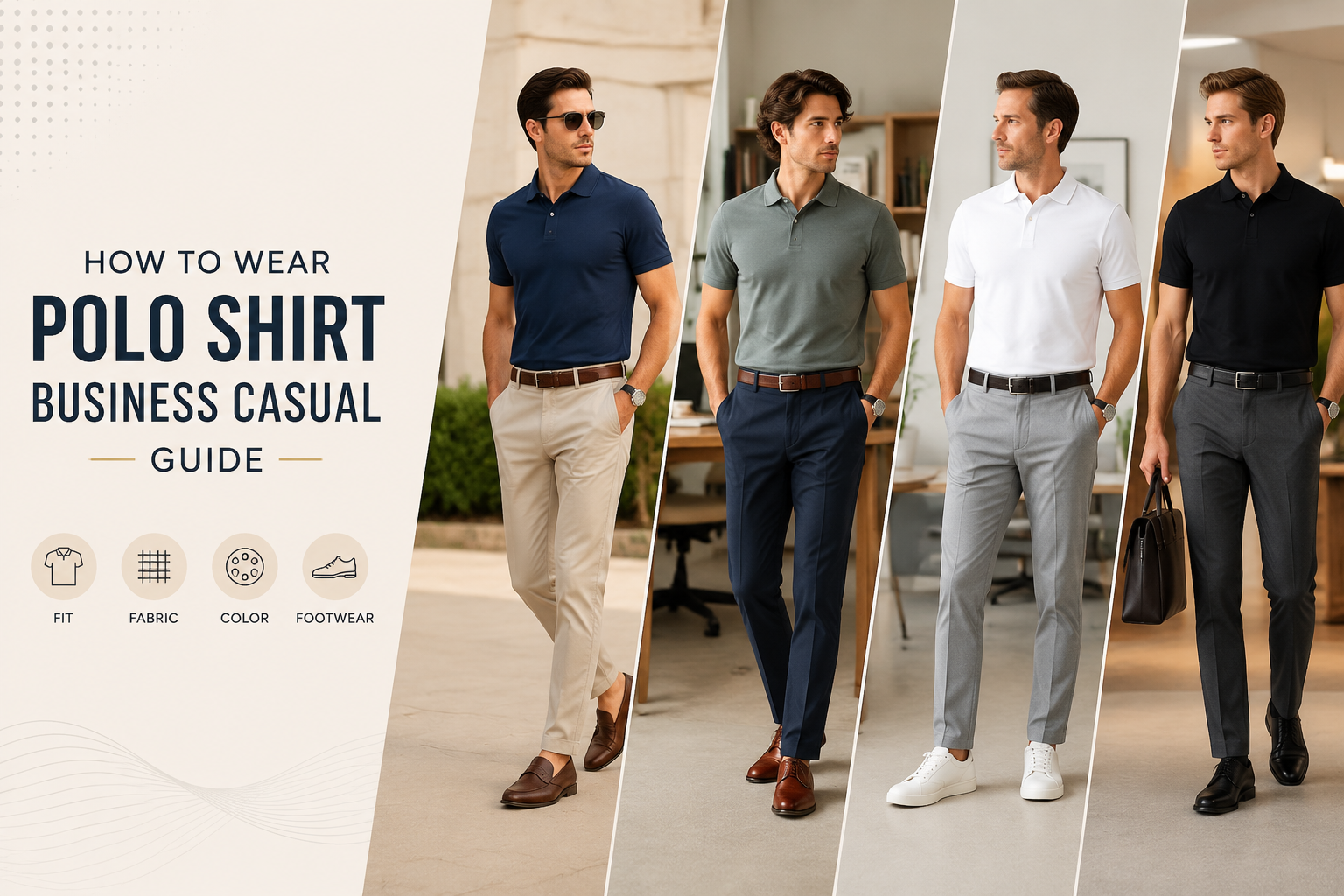
Trousers, not jeans — in most contexts. The clearest route to a polished business casual polo outfit is pairing the shirt with well-fitting chinos or tailored trousers in a neutral colour. Navy, stone, grey, and khaki all work. The trouser should be clean, pressed, and free of distressing. In environments where business casual explicitly permits jeans, a dark indigo or black jean in a slim or straight cut can work with a polo shirt — but this is the lower limit of the spectrum, and it requires the rest of the outfit to compensate.
Footwear anchors the formality level. A polo shirt with chinos and clean leather loafers reads squarely as business casual. The same polo shirt with the same chinos and white-soled trainers reads as smart casual at best. In professional environments, clean leather shoes — loafers, derbies, or simple Oxford-style shoes — are the appropriate choice. Leather-soled or leather-look trainers in a clean colourway can work in very casual business environments but should be treated as the exception rather than the rule.
Outerwear extends the look. A polo shirt worn under a structured blazer is one of the most effective business casual combinations available. The blazer restores the formality that the polo shirt’s knitted fabric removes, while the polo shirt provides the comfort and ease that makes the combination feel modern rather than overdressed. This pairing works across a wide range of business casual environments — from relaxed creative agencies to traditional office settings on non-client days.
Belt and watch. The accessories you wear with a polo shirt in a business context should err toward understatement. A leather belt in a colour that matches or complements your shoes, a simple watch with a leather or metal strap, and minimal additional accessories. The polo shirt’s relative informality means the overall look does not benefit from being accessorised heavily — it benefits from being clean, considered, and consistent.
Colour and Pattern: The Professional Palette
Colour choice in a business casual polo shirt is not about personal expression. It is about controlling how the garment reads in a professional context.
Solid, muted colours are the professional default. Navy, white, light blue, grey, black, and olive are the colours with the strongest business casual credentials. They photograph well, they combine easily with most trouser and shoe options, and they do not draw attention away from the professional context in which you are wearing them. A solid navy polo shirt in a well-fitting piqué cotton is one of the most versatile and reliably appropriate garments in a business casual wardrobe.
Subtle texture over pattern. Piqué texture is inherent to classic polo shirt construction and reads as more formal than a plain jersey weave. Beyond that, subtle tonal patterns — fine stripes in close colours, tonal micro-patterns — are acceptable in most business casual environments. Bold graphic prints, large logo branding, and high-contrast stripe patterns are not. The guiding principle is that the pattern should not be the first thing someone notices about your outfit.
Logo placement and size. A small, embroidered logo at the chest — the classic heritage polo shirt construction — is entirely appropriate in business casual settings and is often perceived as a mark of quality. Large printed logos, graphic across-chest branding, or prominent third-party brand logos in non-heritage formats are not.
Common Polo Shirt Mistakes in Business Casual Settings
Understanding what not to do is as useful as knowing what to do. These are the most frequent errors that undermine an otherwise well-intentioned polo shirt in a professional context.
Tucking versus not tucking. Polo shirts in a professional context benefit from being tucked in when paired with trousers. An untucked polo shirt with chinos reads as weekend dressing. Tucked in with a clean waistband and belt, the same combination reads as deliberate and professional. There are polo shirts specifically cut for untucked wearing — slightly shorter, with a straight hem — that can work untucked in casual business environments, but these are the exception. If in doubt, tuck.
Wearing a polo shirt that is too casual for the context. Not all polo shirts are created equal, and not all polo shirts are suitable for business casual environments. A thin, fast-fashion jersey polo shirt is not the same garment as a structured piqué polo shirt, even if they look similar on a hanger. Know what you are wearing and whether the garment has sufficient structure and quality to carry a professional context.
Ignoring the rest of the outfit. A polo shirt in business casual settings functions as part of a considered outfit, not as the whole outfit. Wearing a polo shirt with cargo shorts, distressed jeans, or worn-out trainers and describing the result as business casual is a misunderstanding of how dress codes work. The polo shirt enables business casual. The trousers, shoes, and accessories complete it.
For Buyers: What to Look For in Wholesale Polo Shirts
For retailers, resellers, and supply chain managers looking to source premium tops and polo shirts in bulk, the same variables that determine consumer value determine which lots are worth acquiring.
Piqué cotton construction in mid-weight fabric (220–260gsm) represents the strongest retail positioning. Clean collar construction — with internal collar band reinforcement and a collar that holds its shape through washing — is the feature that most directly separates commercial-grade polo shirts from value-tier product. Size ratio completeness and consistent colour matching across units are the QC points that generate the fewest post-sale complaints.
Our wholesale T-shirts and tops collection includes polo shirt lots sourced directly from factory overstock — first-quality, original-tag product from cancelled retail programmes across men’s, women’s, and unisex styles. Updated regularly with verified factory surplus lots at competitive bulk pricing.
Browse current polo shirt and tops inventory → View Wholesale T-Shirts & Tops Stocklots
Real-time inspection available: We provide live video inspections via WhatsApp for any current inventory lot. Chat with our sourcing team.
EcoStocklots is a trusted B2B polo shirt and apparel wholesale platform specialising in factory overstock clearance. We connect global importers, discount retailers, and online resellers with verified, defect-free surplus inventory at competitive bulk pricing.